Now Reading: Software Outsourcing Trends in 2025
-
01
Software Outsourcing Trends in 2025

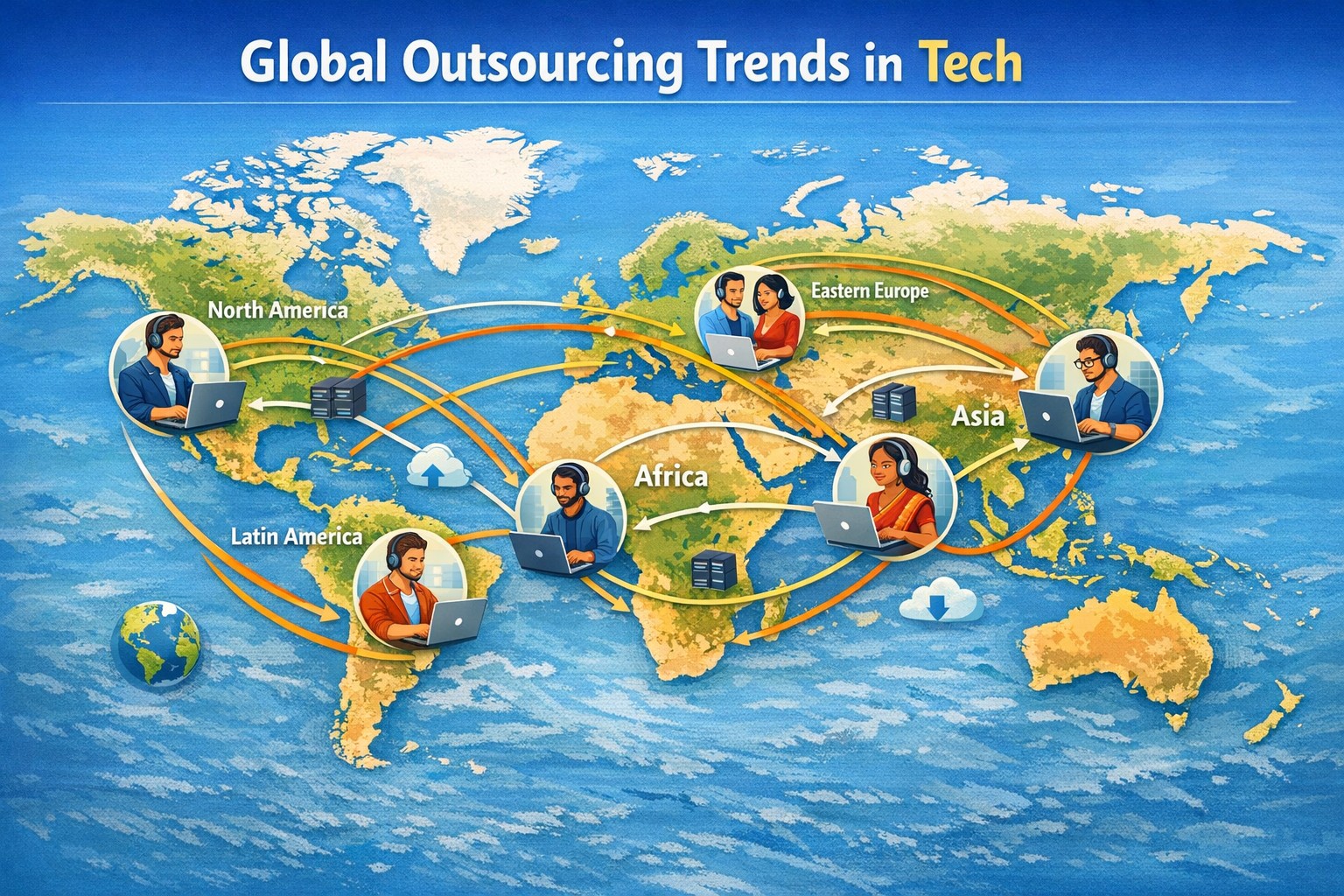
Overview: The 2025 Landscape for Software Outsourcing
The software outsourcing market in 2025 continues to adapt to global pressures—cost optimization, talent scarcity, and rapid digital transformation—while shifting toward more strategic partnerships that emphasize governance, security, and predictable outcomes. Buyers are increasingly selective about which work they offshore, favoring capabilities that integrate with core product teams and business goals rather than simply driving headcount reductions. Vendors respond with scalable delivery platforms, enhanced security postures, and location strategies designed to balance cost, risk, and access to specialized talent. In this environment, the ability to coordinate distributed teams across multiple time zones and regulatory regimes becomes a differentiator, not a backdrop.
Across industries, organizations are rethinking the architecture of outsourcing engagements. The traditional offshore/offshore divide is giving way to hybrid operating models that combine nearshore proximity, onshore visibility, and offshore scale. The motive is to shorten feedback loops, accelerate learning, and align incentives with business outcomes. At the same time, the push toward digital engineering—cloud-native development, AI-assisted software delivery, and integrated security throughout the software lifecycle—is changing what it means to partner effectively. As a result, strategy, governance, and measurement frameworks are moving to the center of outsourcing decisions rather than living in a separate procurement track.
Nearshoring: A Growing Trend in 2025
Nearshoring offers practical advantages for organizations seeking tighter collaboration, easier governance, and more predictable delivery. Proximity in time zones supports faster decision cycles, while cultural affinity and language alignment reduce friction in daily interactions. Enterprises increasingly perceive nearshore destinations as complementary to offshore talent pools, enabling a blended model that buffers against geopolitical risk while preserving scale. This trend is particularly pronounced for product teams that require frequent feedback loops, rapid prototyping, and more hands-on collaboration with client stakeholders.
In practice, successful nearshoring hinges on selecting locations with skilled engineering ecosystems, strong institutional frameworks, and reliable digital infrastructure. The following destinations have emerged as notable options for 2025, each offering distinct strengths—from mature EU delivery capabilities to Latin American hubs that align closely with North American time zones. The common thread is a balance of cost efficiency, talent depth, and governance readability that helps clients move from project-based outsourcing to ongoing partnerships.
- Mexico
- Colombia
- Poland
- Portugal
- Romania
Beyond pure cost considerations, nearshoring supports more seamless scoping, faster risk reviews, and more sustainable team dynamics. It enables clients to maintain closer oversight of critical architectural decisions while still enjoying the benefits of a broad and deep local talent base. For many organizations, nearshoring is not a replacement for offshore capabilities but a strategic enrichment that improves cadence, quality, and collaboration across the software delivery lifecycle.
Cybersecurity and Compliance in Outsourced Projects
Security has moved from a compliance checkbox to a design principle in outsourced software development. As data flows across multiple vendors, environments, and cloud boundaries, the risk surface expands and regulatory expectations tighten. Organizations now demand security as an integral part of engineering—starting at the earliest design discussions and continuing through deployment, operation, and end-of-life. This shift is reinforced by growing regulatory scrutiny, rising customer expectations around data protection, and the increasing prevalence of supply chain attacks that exploit third-party ecosystems. In practice, buyers want assurance that vendors can operate with resilience, visibility, and accountability across the entire delivery chain.
Vendors respond with more rigorous security programs, standardized controls, and continuous monitoring capabilities. Clients increasingly require third-party risk management as a core capability, including verified certifications, transparent incident response plans, and demonstrable adherence to secure development practices. A mature outsourcing partnership now integrates security into every sprint, feature, and release, with measurable outcomes and auditable evidence that security controls remain effective in production environments.
- ISO 27001 certification and SOC 2 Type II reports as baseline assurance indicators
- Zero Trust architecture and granular access controls across all environments
- Security by design in SDLC, including static/dynamic analysis and regular vulnerability testing
- Encryption at rest and in transit, with robust key management and rotation policies
- Data localization strategies and clear data handling agreements aligned to governing regulations
- Incident response, breach notification, and tabletop exercises with defined timelines
Engagement Models and Delivery Excellence
Engagement models in 2025 are steering away from rigid, time-bound arrangements toward flexible, outcome-driven constructs that emphasize continuous improvement and governance maturity. Clients seek arrangements that scale with demand, reduce risk in delivery, and ensure alignment between software outcomes and business value. Vendors, in turn, are investing in platform-enabled delivery, standardized operating models, and transparent performance metrics to sustain trust over multiyear partnerships. The right model depends on project maturity, risk tolerance, and the desired balance between control and speed.
- Dedicated teams that operate as an extension of the client’s product and engineering functions, suitable for long-running programs with evolving requirements
- Staff augmentation that provides flexible access to specialized talent while preserving client ownership of priorities and roadmap
- Managed services or outcome-based engagements where the vendor assumes accountability for delivering defined business outcomes
- Hybrid or build-operate-transfer (BOT) models designed to transfer capabilities to the client over time while maintaining a structured governance framework
To maximize success in any engagement, clients should establish clear governance cadences, shared roadmaps, and joint success metrics from the outset. A phased approach—starting with a well-scoped pilot, followed by progressive expansion—helps ensure alignment, reduces risk, and creates a working rhythm that sustains long‑term collaboration. In addition, the integration of automated tooling for planning, monitoring, and quality assurance accelerates feedback cycles and improves predictability in delivery outcomes.
Talent and Capability Development in 2025 Outsourcing
As outsourcing becomes more strategic, the talent mix driving these initiatives is evolving. The demand for engineers who can operate confidently across cloud platforms, secure DevOps practices, and data-driven product development is rising. Organizations increasingly value partners that can bring not only execution capacity but also domain knowledge, architectural guidance, and product-minded collaboration. This shift emphasizes continuous learning, cross-functional teams, and the ability to quickly transfer knowledge between client and vendor groups to reduce tribal memory and dependency on individual specialists.
Beyond technical skills, successful outsourcing in 2025 depends on soft capabilities such as collaborative problem solving, effective communication across multicultural teams, and disciplined approach to risk and governance. Clients gain more traction when vendors demonstrate mature practices in staffing, onboarding, and ramping capabilities, as well as structured approaches to upskilling and talent mobility. The result is a more resilient delivery ecosystem where teams can adapt to shifting priorities while maintaining high quality, secure, and scalable software products.
Risk Management and Governance for Outsourcing
Governance in modern outsourcing is a shared, continuous discipline rather than a one-off contract appendix. Organizations implement risk-aware operating models, integrated with contract terminology and performance metrics, to ensure alignment across development, security, and operations. The goal is to detect misalignment early, close feedback loops quickly, and adapt to changes in business strategy or regulatory environments. This approach requires transparent dashboards, regular executive reviews, and clearly defined escalation paths that empower both sides to act decisively when issues arise.
| Risk | Mitigation | Example |
|---|---|---|
| Data leakage or improper access control | Enforce least-privilege access, robust identity management, and encryption | Role-based access control combined with zero-trust network segmentation |
| Delivery delays due to dependency complexity | Structured program management, sprint alignment, and clear dependency mapping | Integrated product roadmap with weekly cross-team reviews |
| Regulatory changes impacting data handling | Continuous regulatory monitoring and contract-refresh procedures | Quarterly risk assessment updates tied to policy changes |
| Knowledge transfer risk and vendor lock-in | Documentation, wikis, and regular knowledge transfer sessions | Onshore/offshore rotation and joint onboarding programs |
To translate governance and risk into practical results, organizations embed these practices into vendor selection criteria, contract clauses, and ongoing performance reviews. This requires disciplined change management, clear ownership, and a willingness to adapt governance tooling and processes as the outsourcing relationship matures. The objective is to create a living governance framework that can evolve with technology trends, security threats, and business priorities.
Future Outlook: What Outsourcing Will Look Like in 2025-2026
Looking ahead, outsourcing will be driven by platform-enabled engineering, where automation, standardized delivery pipelines, and modular architectures enable faster, safer execution at scale. Clients will pursue more integrated product squads, blending vendor capabilities with internal engineers to own end-to-end outcomes. The geography of delivery will remain diverse, but the emphasis will shift toward resilience, regulatory alignment, and talent pipelines that support ongoing transformation rather than single-project gains. As AI-assisted tooling becomes mainstream, partners that combine technical excellence with strong governance ecosystems will stand out, delivering higher quality software at a lower total cost of ownership.
Additionally, organizations will increasingly demand stronger alignment between outsourcing arrangements and core business strategies. This means sharper outcome definitions, more rigorous cost transparency, and velocity metrics that capture value delivered rather than activity performed. In a world where cyber risk, talent churn, and geopolitical volatility persist, the ability to orchestrate cross-border teams with unified standards, predictable processes, and trusted governance will be the enduring source of competitive advantage for both clients and their outsourcing partners.
FAQ
What is nearshoring and why is it growing in 2025?
Nearshoring refers to locating software development and IT services in nearby countries to minimize time-zone gaps, reduce travel time, and improve collaboration. In 2025, it grows because organizations seek closer governance, faster feedback loops, and lower risk in cross-border delivery. Nearshore engagements often deliver improved communication, more predictable schedules, and easier alignment with business priorities while preserving the benefits of scale found in global delivery.
How should a company evaluate cybersecurity when outsourcing?
Evaluation should begin with security by design: require standardized certifications (such as ISO 27001 and SOC 2 Type II), implement secure development lifecycles, and insist on regular vulnerability testing and penetration testing. Additionally, enforce encryption of data at rest and in transit, robust access controls, and clear incident response plans. Ongoing third-party risk management, data localization where required, and visibility into vendor security practices are essential for maintaining trust across the delivery chain.
What engagement model should I choose for a software project?
Your choice depends on project maturity, risk tolerance, and desired outcomes. Common models include dedicated teams that integrate with internal product groups for long-running initiatives, staff augmentation for flexible access to niche skills, and managed services or outcome-based engagements where the vendor is accountable for delivering defined business results. Hybrid models that combine elements of these approaches are also common, offering balance between control, speed, and scalability.
What are the top risks in outsourcing and how can I mitigate them?
Key risks include misaligned expectations and governance fragmentation, data security breaches, dependency on specific personnel, and delays due to complex dependencies. Mitigation involves careful vendor selection, explicit contract mechanics, integrated security controls, phased delivery with staged milestones, transparent performance dashboards, and ongoing governance reviews. Building a culture of partnership and continuous improvement is essential to sustaining value over time.