Now Reading: Software Outsourcing Trends in 2025
-
01
Software Outsourcing Trends in 2025


Overview of Software Outsourcing in 2025
In 2025, software outsourcing continues to evolve from a cost-centric shortcut into a strategic capability that accelerates product development, improves resilience, and enables access to specialized talent. Enterprises increasingly expect partners to integrate with product teams, contribute to architectural decisions, and deliver measurable outcomes aligned with business goals. The strongest engagements blend agile delivery, continuous integration and deployment, and security-first thinking to create value beyond traditional vendor-led development.
While price remains a consideration, buyers are placing greater emphasis on governance, risk management, and the ability to adapt to changing requirements. The proliferation of cloud-native architectures, AI-assisted development, and automated testing makes it possible to scale capabilities rapidly, but also raises the bar for vendor qualifications. As a result, organizations are diversifying their supplier portfolios, investing in stronger supplier relationships, and seeking more transparent, predictable delivery models that can weather geopolitical and market volatility.
- Increasing emphasis on nearshoring to reduce cycle times and raise cultural alignment
- Shift toward outcome-based and value-led engagements
- Stronger focus on cybersecurity by design, data localization, and regulatory alignment
- Diversified supplier ecosystems to reduce single-vendor risk
- Investments in continuous delivery, automation, and AI-assisted engineering
Nearshoring: Geographic Shifts and Strategic Balance
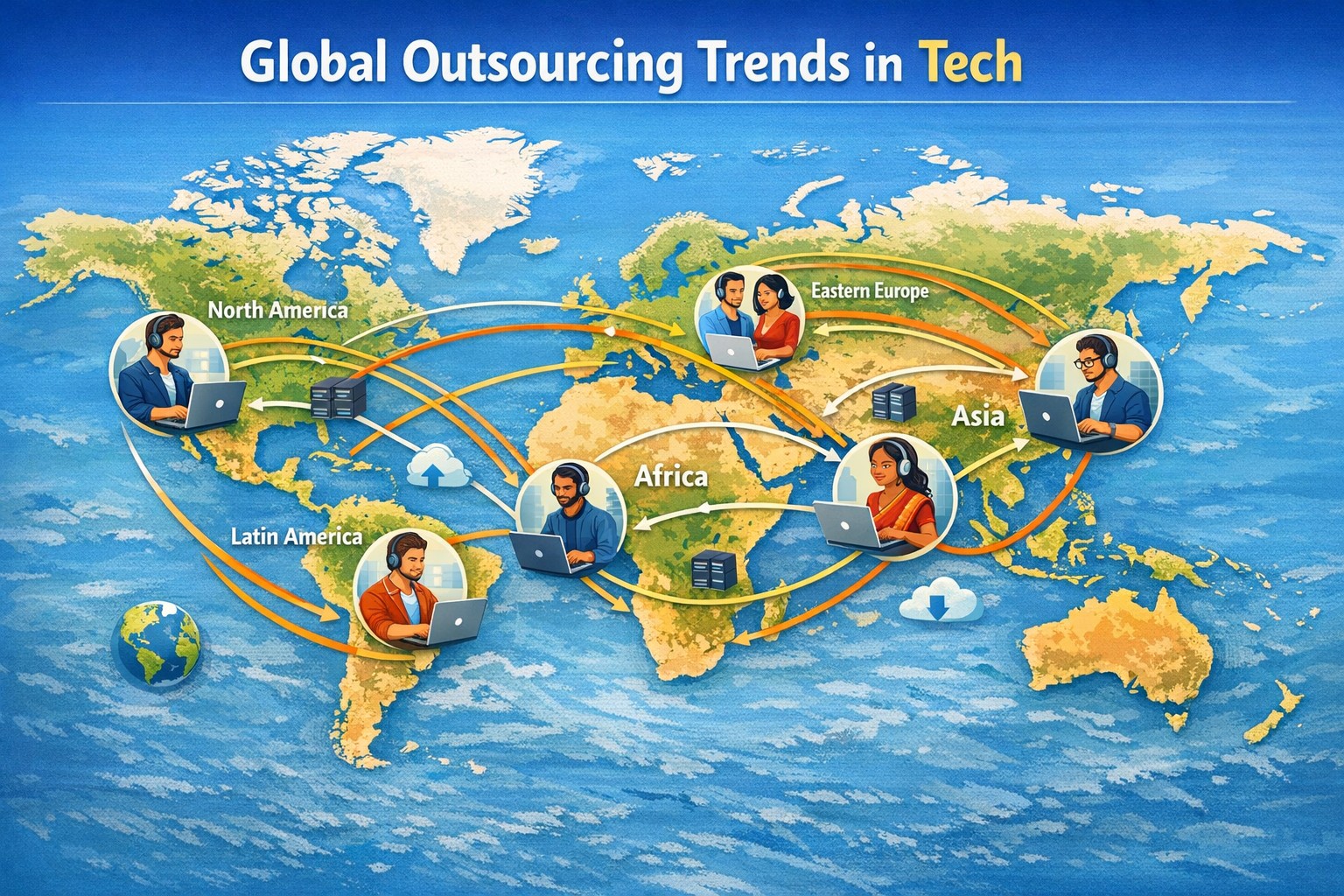
Nearshoring is gaining momentum as teams seek closer time zones, language compatibility, and cultural alignment to streamline collaboration. Regions such as Latin America and parts of Eastern Europe offer substantial pools of skilled engineers, favorable tax regimes, and strong regulatory environments. The proximity advantage translates into faster feedback cycles, reduced travel and communication friction, and a more integrated approach to product development with onshore or nearshore stakeholders.
Beyond operational convenience, nearshoring also improves risk management by enabling more predictable governance, easier co-location when needed, and simpler compliance with data protection requirements. Clients increasingly pursue a multi-sourcing strategy that combines nearshore capabilities with offshore expertise to balance cost, speed, and specialized skills. This approach also strengthens continuity planning by avoiding a single geographic dependency and by building resilient delivery ecosystems capable of adapting to regional disruptions.
Cybersecurity and Data Privacy: Making Security Non-Negotiable
Security considerations have moved from a compliance checkbox to a core differentiator in outsourcing decisions. Organizations expect rigorous security by default, with threat modeling integrated into planning, secure coding practices embedded in development workflows, and continuous monitoring across the supply chain. The growing adoption of DevSecOps, secure software supply chain practices, and explicit data protection commitments highlights the strategic role of cybersecurity in outsourcing programs.
To operationalize these expectations, clients and vendors are adopting stronger controls, such as formal security requirements in contracts, independent assessments, and clear incident response playbooks. Certifications, regular penetration testing, and robust vendor risk management programs help instill confidence that data remains protected while enabling cooperation across dispersed teams. Data localization and residency considerations are now standard requirements for regulated industries, influencing how and where software is developed and deployed.
- Security-by-design requirements in RFPs and contracts
- Continuous security monitoring and rapid incident response
- Mandatory certifications and supply chain risk management
- Data residency, localization controls, and compliant hosting
- Regular third-party security assessments and transparent reporting
Engagement Models: From Fixed-Price to Outcome-Based Partnerships
Engagement models are shifting toward outcomes and shared accountability. Clients increasingly favor structures that align vendor incentives with business outcomes, reduce risk of overruns, and enable faster time-to-value. Models such as managed services, extended teams, and build-operate-transfer arrangements reflect a mature market where governance, product ownership, and technology decisions are collaborative rather than adversarial.
To maximize success, organizations are investing in clear governance frameworks, joint roadmaps, and performance dashboards that track both technical delivery and business impact. Transparent pricing and well-defined acceptance criteria help prevent scope creep, while flexible scaling mechanisms ensure teams can adapt to changing priorities. As delivery ecosystems become more distributed, effective coordination between product owners, engineering leads, and vendor executives becomes a critical determinant of outcomes.
- Outcome-based contracts and service-level outcomes
- Build-Operate-Transfer (BOT) and Global Delivery Centers
- Managed services with product ownership
- Extended teams and dedicated squads
- Hybrid onshore-nearshore-offshore models
Technology Trends and Delivery Practices
Technological advancement continues to redefine outsourcing capabilities. AI-assisted development, automated testing, and intelligent code generation accelerate delivery while raising expectations for quality and security. Cloud-first strategies, multi-cloud or hybrid deployments, and automated DevOps pipelines enable faster iteration cycles and more reliable production releases. Delivery practices emphasize modular architectures, clear interface contracts, and robust observability to support rapid change without compromising stability.
At the same time, organizations invest in upskilling and cross-functional teams to ensure a seamless collaboration between product, design, and engineering. Standardization of tooling, governance, and security controls reduces cognitive load for distributed teams and improves predictability. The result is a more resilient software supply chain capable of delivering complex, data-intensive applications in regulated environments while maintaining velocity.
Cost, ROI, and Risk Management
Financial considerations in outsourcing extend beyond headline rates. Total cost of ownership now includes onboarding, knowledge transfer, data protection, regulatory compliance, and ongoing security investments. Currency fluctuations, inflationary pressures, and regional talent dynamics can influence price stability and long-term value. Organizations increasingly use value-based criteria—such as time-to-market, defect reduction, and customer impact—to justify engagements rather than relying solely on hourly rates.
To manage risk effectively, buyers implement rigorous due diligence, formal risk registers, and continuous governance. Regular audits, clear escalation paths, and predefined remediation plans help maintain momentum even when unexpected challenges arise. The emphasis is on predictable delivery through transparent metrics, milestone-based checks, and collaborative risk mitigation that aligns vendor incentives with client outcomes.
Implementation Roadmap for 2025
A practical path to success blends strategic planning with disciplined execution. Start by translating business objectives into measurable engineering outcomes—for example, reduced time-to-market for a new feature set or a specific improvement in application security. Use a structured vendor selection process that prioritizes security posture, architectural alignment, and cultural fit, followed by a phased onboarding that includes pilot projects, knowledge transfer, and governance alignment.
As programs scale, implement a staged rollout with clear milestones, risk controls, and performance reviews. Establish a joint product backlog, define acceptance criteria, and set up automated testing and monitoring pipelines. Continuous improvement loops—root-cause analysis of defects, post-implementation reviews, and quarterly architecture refreshes—help sustain long-term value and adapt to evolving business needs.
FAQ
What is nearshoring and why is it growing in 2025?
Nearshoring refers to relocating software development activities to nearby regions to reduce cycle times, improve communication, and increase cultural alignment. In 2025, nearshoring gains traction due to faster feedback loops, easier collaboration across time zones, and stronger regulatory compatibility. It complements offshore capabilities, providing a balanced mix of cost efficiency and delivery speed that can adapt to changing project requirements.
How does cybersecurity shape outsourced software development in 2025?
Cybersecurity is embedded into every phase of outsourced development, from contract language to architecture and operations. Emphasis on secure coding, supply chain integrity, continuous monitoring, and incident response reduces risk and builds trust with customers. Organizations commonly require security certifications, regular third-party assessments, and clear data protection commitments to safeguard sensitive information across distributed teams.
What engagement models yield the best outcomes in 2025?
Outcome-based contracts, build-operate-transfer arrangements, and extended teams are among the most effective models in 2025. These approaches align vendor incentives with business results, enable scalable capacity, and foster joint ownership of roadmaps. Managed services and dedicated squads offer governance and flexibility, while hybrid models allow teams to blend nearshore and offshore strengths for optimal velocity and reliability.
What should buyers look for in a software outsourcing partner?
Key factors include a proven security posture, architectural alignment with your product strategy, and a track record of delivering measurable business outcomes. Look for transparent governance, clear pricing models, and a culture of collaboration that emphasizes long-term partnerships over one-off project delivery. Strong client references, accessible metrics, and a demonstrated ability to operate in regulated environments are also important signals of a capable partner.